
'The success or otherwise of Modi's foreign policy will largely depend on the equation he is likely to strike with Donald Trump.'

India's historical focus on its continental borders has overshadowed its maritime ambitions, but that is changing quickly, notes Ajai Shukla.

"We are committed to building a new India. We have to do this as early as possible," he said.

Here is the full text of the joint statement issued by India and the US.

The expulsion is likely to cloud India-China ties as Narendra Modi visits China for the G-20 Leaders Summit on September 4-5 and Xi Jinping is scheduled to be in Goa for the BRICS meeting on October 15-16.

'Building on the potential for closer ties is the changing narrative in each country about the other. The Chinese narrative on India has become significantly more positive over the past few years,' says Walter Andersen and Zhong Zhenming.
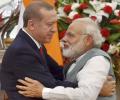
Turkish President Recep Tayyip Erdogan's has been trying to mollycoddle India with sweet nothings while having a very close relationship with Pakistan.

'New Delhi showed itself willing -- at least for a period -- to tolerate the risk of conflict and to withstand Beijing's implicit and explicit threats.' 'But it also continued to try to cut some kind of deal with China to reduce tensions.'
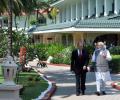
Big ticket defence deals including purchase of missile systems, frigates and joint production of helicopters were sealed on Saturday.

Prime Minister Narendra Modi had gone to China with a bagful of initiatives, but not all seems to have been fulfilled given China's reluctance to go the whole hog with him
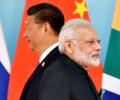
'The events of 2020 have actually put our relationship under exceptional stress.' What External Affairs Minister Dr Subrahmanyam Jaishankar told the All India Conference of China Studies on Thursday, January 28, 2021.

India's decision to skip the meeting came after a year of bilateral discord over China's stubborn opposition to India's entry into the Nuclear Suppliers' Group and a UN ban against Pakistan-based terrorist group Jaish-e-Mohammed leader Masood Azhar.

While trying to persuade North Korea to give up its provocative actions, engaging China is the first hurdle that world leaders will have to deal with, says Rajaram Panda.

PM Modi seems to be gradually ending India's strategic ambiguity

'We have never had a policy regarding Pakistani artistes working in India.' 'We welcome them with open arms and that remains the official policy of the Indian government, including the current dispensation.'
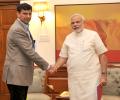
The government's critics say that the Prime Minister failed to rein in vicious and unprecedented personal attacks on the central bank chief by the likes of Rajya Sabha MP Subramanian Swamy.

'We are witnessing a spectacle of breathtakingly creative diplomacy at work, riveted on the firm foundations of the country's strategic autonomy,' says Ambassador M K Bhadrakumar.

India looks less equal to China than 5 years ago, the strategic alliance with the US is hobbled by trade, and Pakistan is looking anything but chastened by Balakot. What has gone wrong? asks Shekhar Gupta.

Making it easier to do business is a key element of our strategy, says Foreign Secretary S Jaishankar.
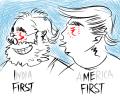
'Even in this age of self-willed and authoritarian leaders and spontaneous gestures, a script is still written,' notes Ambassador B S Prakash, imagining the 'talking points' are for the India-US summit on June 26.

'Today the Chinese think they can slap India, and there will be no consequences.' 'They must be made to feel the consequences through any and all means,' says Rajeev Srinivasan.

'There will be some issues of contention, especially on H1B visa and on trade policy.'

'Political meetings will be a mere side show; the main show is economic investment and the business partnership. The success of Modi's US visit will be judged on the basis of India's ability to attract American investment and setting up of manufacturing in India to give jobs to millions,' says Colonel Anil A Athale (retd).

Secretary Tillerson met with Foreign Secretary Jaishankar on Friday to discuss the US-India relationship and the agenda for Prime Minister Modi's meetings at the White House on June 26, a State Department spokesman said told PTI.

Modi has debunked the uncontested wisdom of foreign and strategic policy remaining unchanged and running on a broad national consensus. This is clearly seen in his unhesitating embrace of the US and the clear hardening shift in India's stance on Pakistan, says Shekhar Gupta.
Right from conducting nuclear deterrence patrols in 2015 to its destructive space programme, from its back-tracking on economic commitments to its hardened positions on Sino-India border deal -- its approach with India spells Adversarial with a capital A, says Shehzad Poonawalla

'One must remember that a dragon has a forked tongue,' warns Vivek Gumaste.

The BRICS summit made clear that China's support for Pakistan is unwavering. China will continue to pressure India to ease tensions with Pakistan and resolve the Kashmir dispute.

Beijing is clearly rattled by the Dalai Lama's visit. Unlike the 2009 visit, which was a four-day religious tour, the current visit is a high-decibel, 10-day affair, without the fig leaf of a "religious event", reports Ajai Shukla.

Prime Minister Malcolm Turnbull's first State visit to India is an indication of the success of India's Act East Policy, says Dr Rahul Mishra.
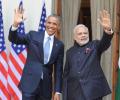
Modi and Obama surely put India-US ties in fast-forward mode. But 5 things deserve careful attention.
'Relations between India and Japan are robust and devoid of either shadow of history or any irritant.' 'In fact, there is plenty of warmth and goodwill earned over history. There are no negatives but only opportunities,' notes Dr Rajaram Panda.
'India will keep trying to avoid conflict.' 'This is the moment when we draw a line in the sand.'

One thing Beijing must understand is that India is not obsessed with being a threat to China but only wants a rightful place for itself in the world, says Sanjeev Nayyar.

The Dalai Lama's Arunachal visit is not likely to derail the relationship but it is enough to signal the Chinese that India is also willing to flash the Tibet/Taiwan card should the need arise, says Sana Hashmi.

The decision to not attend the forum attended by 28 heads of state and 130 national delegations is a clear break from its usual policy of going along with the crowd.
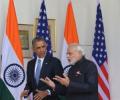
It is for the companies and the industry to ascertain where they want to run with the US-India civilian nuclear agreements reached by Washington and New Delhi, says United States Assistant Secretary of State Nisha Biswal. Aziz Haniffa reports for Rediff.com from Washington, DC

'It is in the interest of both sides that the visit of the US President is seen as being successful. Both sides have invested considerable political capital in it. This rapid exchange of visits and the decisions taken have to be justified, beyond the symbolism, which is no doubt important in itself. This opportunity to impart a fresh momentum to ties should not be missed,' says former foreign secretary Kanwal Sibal.

Modi's arrival has changed the optics of the visit. There is a different demonstration of the confidence level in the Indian leadership, but not much has changed beyond that, reports Sheela Bhatt/Rediff.com.

'This novel format of diplomacy -- the informal summit -- will not only facilitate bilateral communication and reduce miscalculations at the very top level of the two governments, but possibly open the space for China and India to speak in one voice on various issues of mutual concern,' note Feng Renjie and Ding Kun Lei
